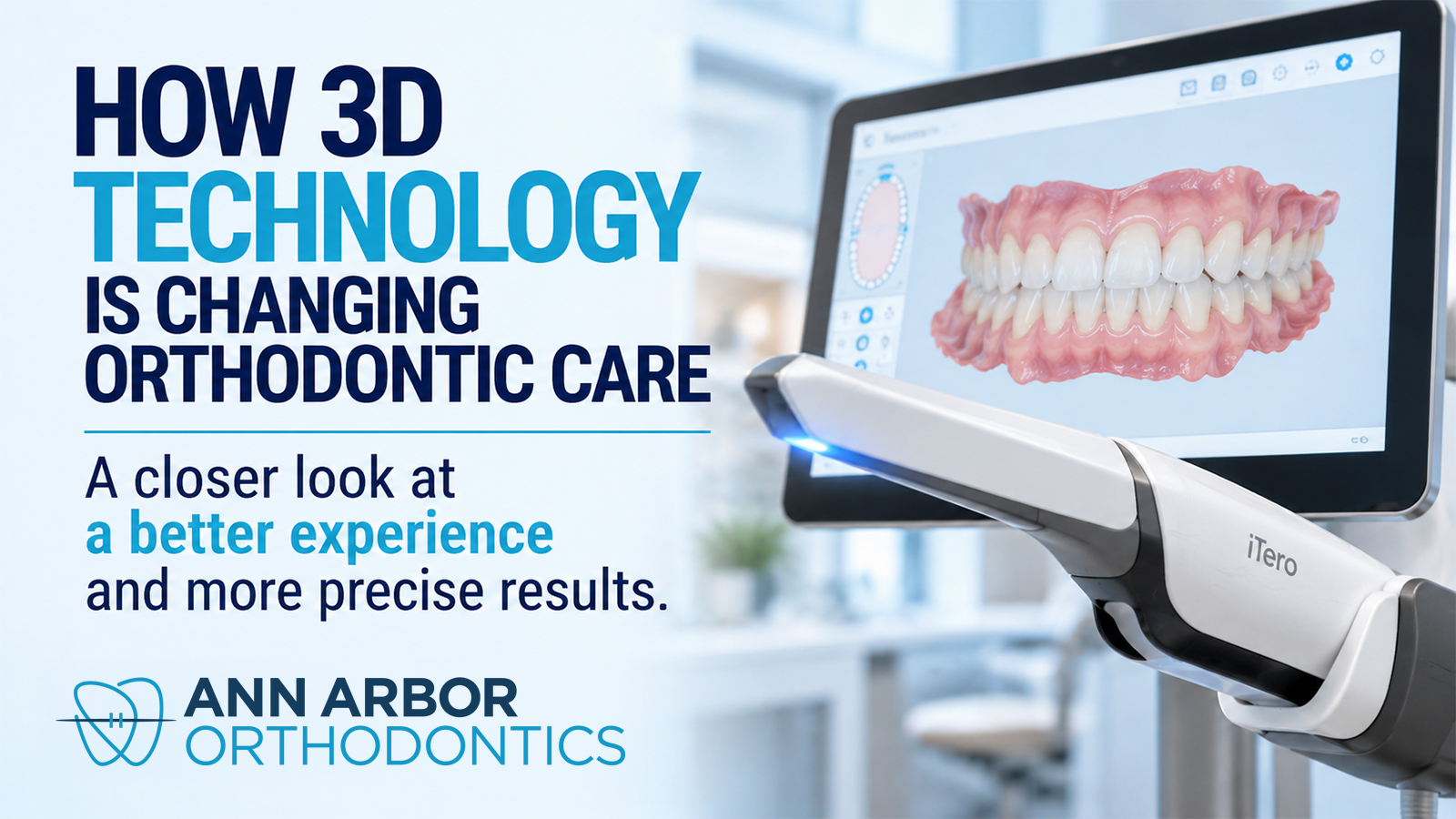
After a 3D scan, many parents ask a fair follow-up question: what actually happens to all that digital information? It's one thing to watch a model of the teeth spin on a screen, and another to understand how that model shapes the braces, aligners, or retainers a patient ends up wearing.
At Ann Arbor Orthodontics, we think of the scan as the starting line, not the finish. The real value of 3D technology shows up in the steps that follow: how a treatment plan gets mapped out, when we need a deeper look below the gums, and how custom appliances are made to fit. Here's what each of those steps involves.
A digital scan captures the teeth and gums from thousands of angles and assembles them into a precise 3D model of the bite. You can read about the scanning visit itself on our 3D Scanning page or in our earlier article, How 3D Technology Is Changing Orthodontic Care in Ann Arbor. This article picks up where those leave off.
Unlike a plaster mold, a digital model can be measured in fine detail, viewed from any direction, and laid over later scans to show exactly how the teeth have moved. Nearly every treatment decision that follows is built on it.
Planning software lets the orthodontist move each tooth virtually, step by step, toward its final position before any appliance is placed. With clear aligners, those steps become the aligner series itself, since each tray is designed to carry the teeth from one stage to the next. Many patients also get to see a simulated preview of their finished smile at this stage.
That simulation is a helpful guide, but it isn't a guarantee. Real teeth respond to bone, growth, and how faithfully aligners or rubber bands are worn, so we check progress at each visit and refine the plan when something changes.
A surface scan can't show what sits beneath the gums. When a case involves an impacted tooth, unusual root positions, or questions about the shape of the jaw, a cone beam CT (CBCT) scan, which is a type of 3D X-ray, can fill in those details.
CBCT isn't routine for every patient, because it uses more radiation than standard dental X-rays. Research on CBCT in orthodontic practice supports using it selectively, only after an exam shows the extra detail will meaningfully change the plan, and impacted teeth are one of the clearest reasons to order it. It can also help when orthodontics is paired with Corrective Jaw Surgery.
3D printing is where the digital plan becomes physical. Clear aligners are typically shaped over a sequence of printed tooth models, one for every stage of treatment. For braces, a printed transfer tray can hold each bracket in the exact spot chosen during planning so it's placed accurately on the tooth, an approach known as indirect bonding. Retainers are often made from printed models, too.
These printed pieces hold up well in research. A 2025 systematic review on 3D printing in orthodontics reported that printed bonding trays and retainers reach clinically acceptable accuracy, while printing aligners directly is a newer method that is still being studied.
Put together, these tools change the treatment experience in a few practical ways:
Not on its own. Teeth move at the pace healthy bone allows, and no software changes that biology. Where 3D tools help is in reducing guesswork, cutting down on remade appliances, and keeping each stage on target, which supports a smoother path to the finish. The overall timeline still depends on the type of correction needed, your child's growth, and consistent wear of appliances at home.
To keep learning, explore how Invisalign treatment is planned, see what's involved in Comprehensive Orthodontic Treatment, or read about life after braces on our Retainers page. When you're ready, schedule a complimentary orthodontic evaluation in Ann Arbor and we'll show you how these tools would fit into your own treatment plan.
